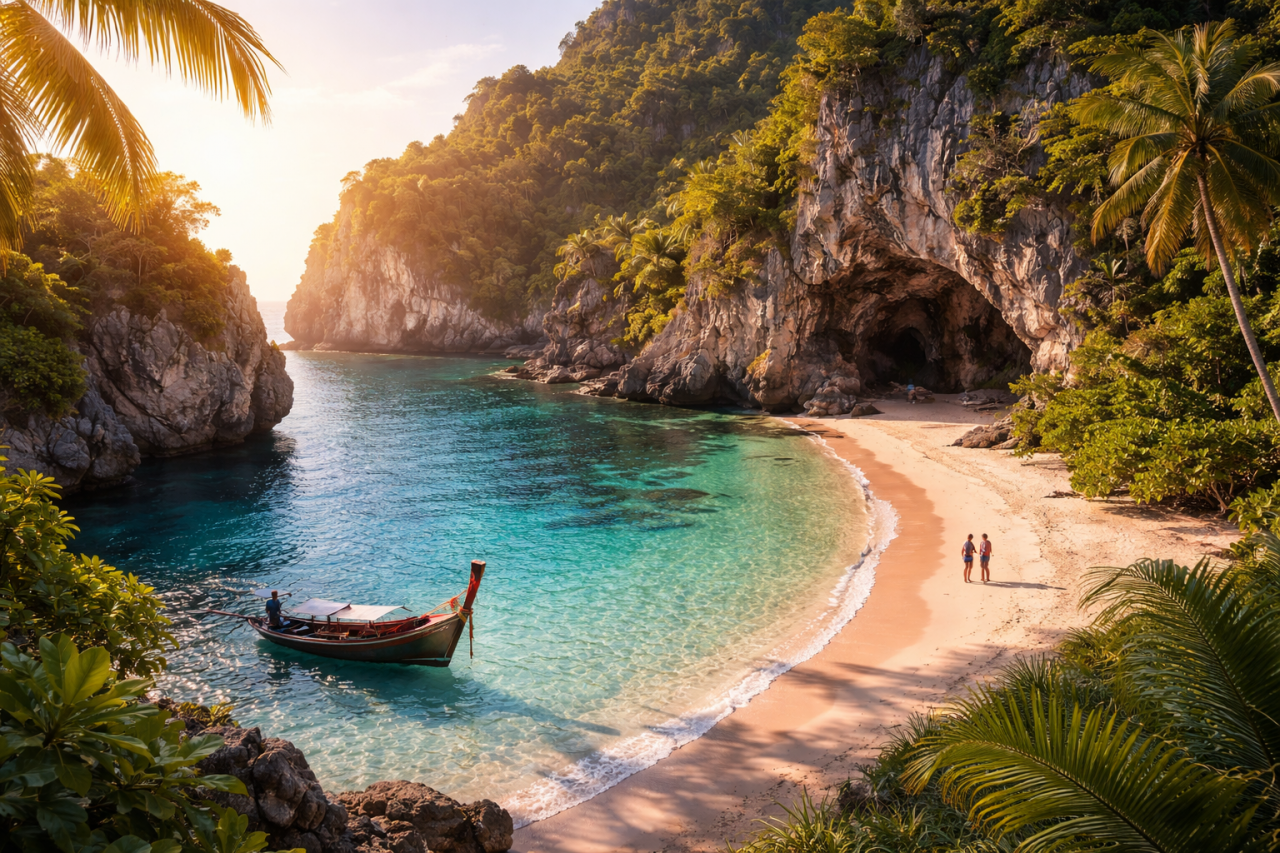
There is a small corner of Koh Samui that keeps its voice low, where the tide moves like a secret and the rice paddies breathe stories at dusk. It’s not the main postcard beach, and it’s not loud with rooftop bars. It’s a place you find because you decide to slow down, ask a vendor for directions, and follow a dirt track until your map starts sounding like a friend.
How I stumbled on it — a quiet doorway
I arrived on a midweek ferry and took the slow route inland, not out of necessity but because the road along the coast felt like a prelude. A local mototaxi driver mentioned a “little bay” with a single family-run café and a tree with hammocks. He laughed when I asked for the name and said, “People who love it don’t tell.” That was enough.
Walkable coves, one beachfront house, and fishermen who repair nets under palm shade: those are the elements. The air carries faint curry steam from a nearby village kitchen, and when a bell rings from a neighboring temple, everything lines up for a quiet, ordinary kind of beauty.
Where to go and how to get there
The most important orientation is this: be prepared to turn off the main roads and trust a local’s directions. Public transport reaches the island’s major hubs, but this place asks for curiosity.
- From Nathon Pier: Take a songthaew toward the interior, then switch to a mototaxi for the last stretch down the unpaved lane. Ask the driver to drop you at the “small hammock bay” or describe a nearby landmark like a temple or family-run café.
- From Chaweng and Lamai: It’s a 30–50 minute drive depending on traffic. Consider renting a scooter if you’re comfortable riding; the final section is narrow and shaded.
- If you rely on maps: You can search for nearby mainstream points first—such as “Nathon Pier” or “Fisherman’s Village, Bophut”—and then ask a local for the quiet bay by name.
Practical tips:
– Bring cash for small cafés and motorbike drivers.
– Wear shoes that can handle sand and uneven paths.
– Visit in the late afternoon for softer light and cooler air.
What to expect when you arrive
Expect a simple shoreline with a smattering of boulders, a couple of wooden jetties, and low-key family restaurants. There is no beach club playlist here; rather, someone might be frying fish and singing under their breath.
- Shade: A line of casuarina or coconut trees often offers hammock spots.
- Food: Look for stalls selling grilled fish, som tam (green papaya salad), and fresh coconut water.
- Crowd: Mostly local families and a handful of travelers who prefer low-key places.
Small details you’ll notice:
– The way children play with crabs near the rocks.
– A statue or small shrine tucked into a bungalow porch.
– The slow, contented flapping of laundry in salt air.
Places nearby worth searching for
If you like to anchor your wanderings with familiar spots, these nearby places help you orient yourself. You can search for them on Google Maps by typing the exact names below.
- Nathon Pier — the island’s main ferry point and administrative town.
- Fisherman’s Village, Bophut — a pleasant stretch of restaurants and a weekly walking street market.
- Wat Sila Ngu (or other small local temples) — temples often serve as local landmarks and gathering places.
- Local family cafés and seafood shacks — look for handwritten menus and low plastic chairs.
Tip: If you want to confirm exact locations, search each place by name on Google Maps and then ask someone locally for directions to “the small hammock bay” or “the quiet cove with one café.”
Where to eat — small meals, large flavors
The food here is straightforward but deeply satisfying. Family-run kitchens focus on freshness and comfort rather than trendiness.
- Look for grilled mackerel or snapper served with chili-lime dipping sauce.
- Order a bowl of tom yum or tom kha if the cook offers it; small roadside cooks can make them with a generosity that belies the scale of their stall.
- For dessert, seek coconut-based sweets: a steamed coconut custard or a warm pancake brushed with condensed milk.
A few practical dining notes:
– Ask whether dishes are spicy; “phet nit noi” means a little spicy.
– Keep some tissues or wet wipes handy — many places don’t offer them.
– Bring small change; many spots prefer exact payment.
Best time of day to visit
Early morning and late afternoon offer the best light and mood. Mornings are cool and the fishermen may be sorting their catch. Late afternoons bring a slow hush and a deep orange wash over the palm fronds.
- Morning: Quiet, cooler, good for photographs and fresh-market visits.
- Late afternoon to twilight: Softer light, more people returning from the sea, restaurants firing up for dinner.
A few thoughtful dos and don’ts
This place is small and community-centered. Small courtesies go a long way.
Do:
– Speak a few polite Thai phrases: “Sawasdee” (hello) and “Khop khun” (thank you).
– Support local businesses — buy a coconut or a plate of food.
– Leave no trace: take your rubbish with you if bins are scarce.
Don’t:
– Expect Western-style facilities everywhere.
– Shout or be loud around homes and temples.
– Disturb fishermen or their gear; ask before taking photos of people at work.
A quiet night and slower rhythms
If you stay until nightfall, you’ll notice how the sky settles and the village lights blink on like tiny, private constellations. There might be a single lantern-lit table on the sand where a family shares one fish and many stories.
Sleep in a simple bungalow or a guesthouse run by a family who knows names and breakfasts. The beds are comfortable enough; the mornings come with coffee and a soft, certain welcome.
Final note — why I keep coming back
There is a kind of reserve to this corner of Koh Samui that rewards attention. It doesn’t demand you be a photographer or a trend-follower. It invites you to slow down, listen for the bell at the temple, learn which stall serves the freshest coconut desserts, and then leave with the quiet satisfaction of finding something that feels like it belongs only to you and the people who live there.
If you go, carry patience, curiosity, and a willingness to ask for directions with a smile. The place itself will do the rest.

Comments (0)
There are no comments here yet, you can be the first!