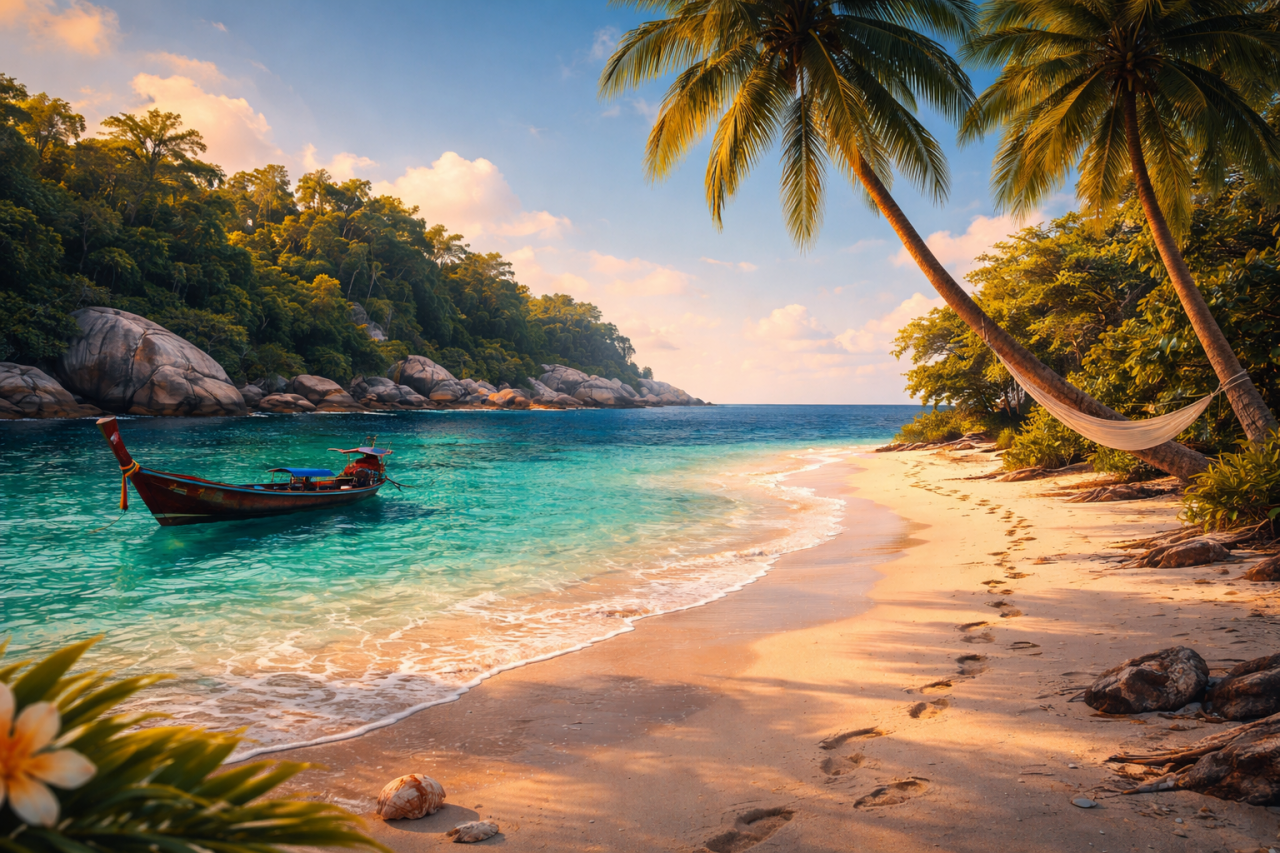
There is a particular hush to parts of Koh Samui that keeps time slow. The island’s usual postcards—palm-lined crescents, scooters threaded through sleepy villages, fishing boats that look as if they will never reach full speed—are all true. But there are quieter corners where the tide and the trees still set the pace, and where a day can be spent noticing small, precise things: the salt on a fingernail, the way a coconut frond makes its own shadow, the slow sorting of shells by a child who is learning to see.
Below I write about one such beach and the island that holds it. I write with the calm curiosity of someone who has learned to read places the way sailors read wind: patient observation first, opinion later. Practical tips are woven in, not as commands but as gentle suggestions that help the small discoveries stay intact.
Finding the beach: where quiet remains
Koh Samui has a dozen named beaches that most guidebooks will point to. This post is about a stretch that remains comparatively untouched, where development thins and the rhythms are more local than touristic. If you want to find it, walk the less-traveled coastal paths between the known points and trust the narrowing of footprints.
Useful nearby places to orient yourself:
– Bophut Fisherman’s Village — a good compass point if you are approaching by road or boat. You can search for it on Google Maps by typing: Bophut Fisherman’s Village.
– Big Buddha (Wat Phra Yai) — visible from several points on the northeast coast and useful as a landmark. You can search for it on Google Maps by typing: Wat Phra Yai (Big Buddha).
– Choeng Mon Beach — a quieter neighbor that often serves as a buffer before the more untouched sections. You can search for it on Google Maps by typing: Choeng Mon Beach.
If you prefer to navigate by motorbike, take the smaller coastal roads rather than the ring road when you see signs for local piers, temples, or school accesses. Walkers will find the greatest rewards by following the tide line when the sun is low.
The day there: small observations
Arrive just after dawn. The light slices through palms with a thin, patient clarity that photographs poorly but feels precise in the skin. The beach will be quiet enough that each sound has space to be understood: a distant longtail engine, the flap of a heron’s wings, the soft clack of a boatrope.
There are no aggressive vendors here, and no sunbed armies. Shade comes from an informal choir of trees rather than a hotel’s lines of umbrellas. You can make a small ritual of finding the single flat rock that faces the sea and sitting there with a thermos or a coconut, listening to the tide count seconds.
Bring:
– A reef-safe sunscreen and a light sarong. Shade is not guaranteed.
– Refillable water and a small bag for rubbish. The less you leave, the longer this place remains untouched.
– A comfortable pair of sandals for walking over coral rubble and a hat that will not fly off.
Short walks along the shore reveal mangrove fringes and pockets of pebbles with shells. If you are quiet, ghost crabs work the surf like little mechanics, pausing to inspect you as if you are an odd stick that happened to be animated.
Local life and how to be a considerate guest
This part of Koh Samui still feels lived-in. Houses sit near the sand, longtail boats are parked like tools, and morning markets open with a gentle, utilitarian air. There is no point in arriving with the assumption that the place exists for your pleasure; it does not. It is a neighborhood with tides.
How to engage kindly:
– Buy a coffee or a snack from a local stall rather than bringing everything from elsewhere. Small purchases matter.
– Ask before photographing people up close. Children are curious but also taught to value privacy.
– If you take shells or driftwood, take only what would otherwise wash away. Leave small habitats intact.
A couple of local places worth knowing:
– Bophut Morning Market — a modest, practical market where fishermen and bakers set up before the heat. You can search for it on Google Maps by typing: Bophut Morning Market.
– Local longtail boat operators — you will see them on the sand or moored off pocketed piers; speak to them directly for short trips. Ask around the village or at the pier for the name of a trusted operator rather than hiring the first person who approaches.
Food and simple meals
There is no grand dining scene here; the best meals are uncomplicated and well-made. Small family-run restaurants serve curries that have been adjusted over generations, seafood grilled over charcoal, and bowls of clear soup that taste of the sea without theatrics.
Good choices:
– A local beachfront eatery (look for the place where fishermen bring their morning catch and where the menu changes daily).
– Street stalls for mango sticky rice or a simple bowl of khao soi adapted to the island palate.
When you eat, order something unfamiliar and ask the cook how they would eat it. The answer is usually a small education in necessity and care.
Where to sleep if you want to stay near the quiet
There are a few modest guesthouses and bungalows that lean into the island’s slower edges. They are not extravagant. They offer hammocks, fans, and windows that open to the sound of coconut leaves. Book directly where possible; smaller places depend on word of mouth and the steady trust of guests who treat the property and neighborhood with respect.
A practical note on timing: the high season brings more visitors, and places that sit quietly in the low season sometimes change. If you want true quiet, visit in the shoulder months—late April to early June, or September to early November—when the light is warm, prices are moderate, and the island breathes a little easier.
Getting there and getting around
Koh Samui is reached by plane, ferry, and the patient arrival of longboats. Once on the island, the scooter is a sensible, economical way to reach less-visited shores. Drive steadily and assume local drivers will not rush to correct a mistake; defensive riding keeps everyone calmer.
Notes on transport:
– If you take a ferry, arrive early and let the morning give you the first views of limestone and palms.
– Rent a motorbike from a reputable local shop; check brakes, lights, and tires before you leave.
– Taxis and songthaews operate on the island but can be less flexible for reaching tucked-away paths.
Simple ethics of visiting
An untouched place is not untouched by people; it is simply less altered by market forces. The work of preserving such a place is quiet and often invisible: locals patch a net, pick up a bit of floating plastic, teach a child to read tide marks. Your role is small and practical.
Respect the rhythm:
– Reduce single-use plastics and carry a small trash bag.
– Keep volume low and lights dim after dark.
– Support local services directly when possible—pay for a guide, leave a note for a cook, mention places you liked to friends who visit later.
Final impressions
There is a particular pleasure in being at a beach that still holds spaces for private observation. Koh Samui can be theatrical; this stretch is not. It rewards patience and a willingness to notice details—how the tide leaves a line of tiny seaweed flags, how a fisherman mends a net with hands that move like a slow clock.
If you go, bring curiosity rather than a checklist. Sit more than you photograph. Talk to the people who live here, but listen more than you speak. Places like this keep their calm when visitors remember they are guests rather than conquerors. The island will then give you small, precise gifts: a beautifully ordinary sunrise, a bowl of soup that tastes like the sea, the memory of silence punctuated only by water.

Comments (0)
There are no comments here yet, you can be the first!